 +44 7570 563799Free quote
Quick answer
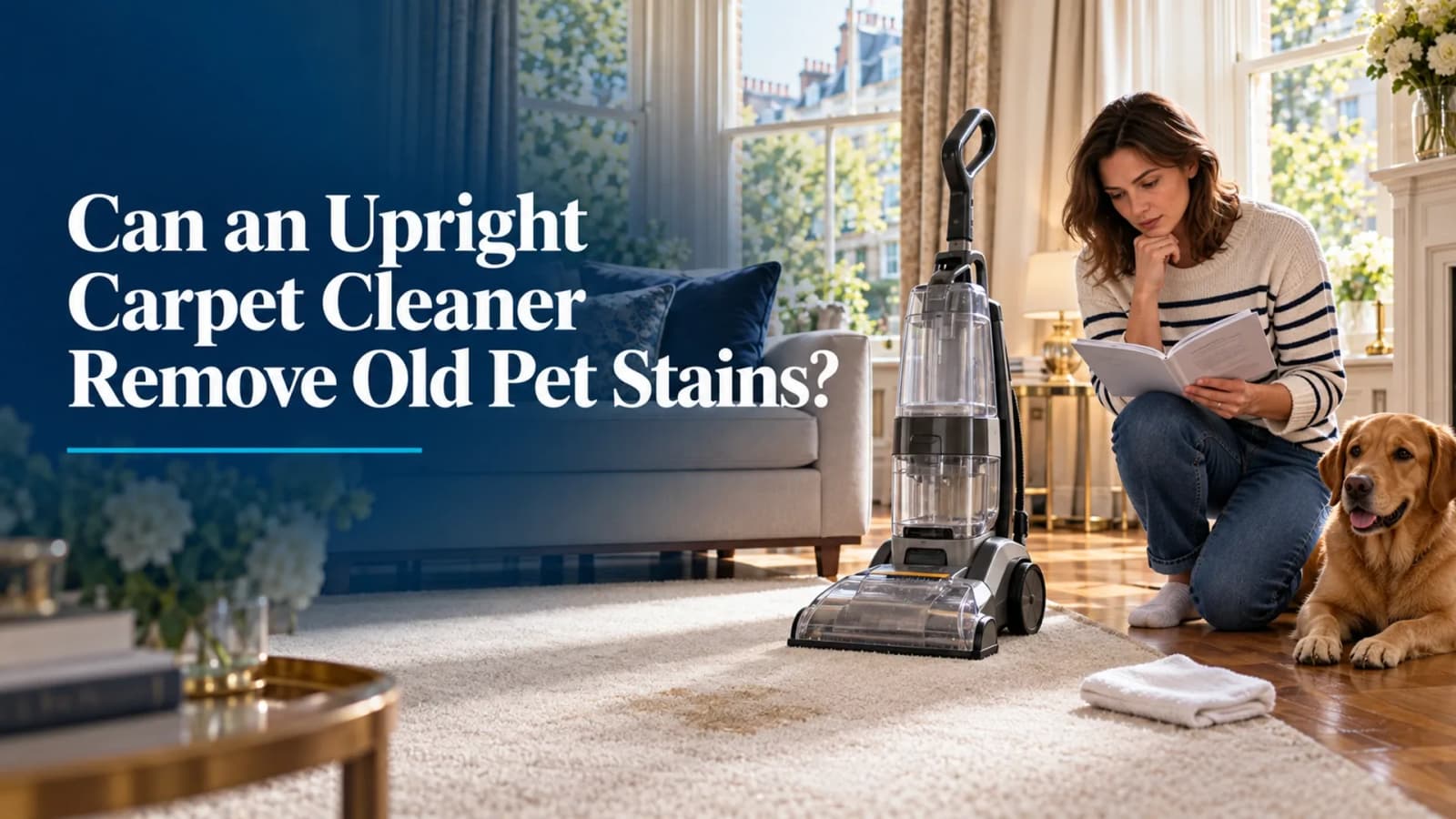
An upright carpet cleaner may improve surface soil and some old pet marks, but it cannot guarantee removal of urine odour or permanent colour damage. Check the carpet, machine and product instructions before use. A cleaner-looking surface does not show whether urine reached the backing or underlay. If smells return or the material is uncertain, request an assessment before another wet treatment.
Introduction
When dogs or cats have left marks over several years, an upright carpet cleaner can look like a convenient way to tackle everything in one afternoon. The difficult part is knowing whether the visible patch is the whole problem and whether your carpet is suitable for the proposed treatment.
This guide helps you make that decision before repeatedly washing the same area. It explains the information to check, what to record about older pet accidents and when a professional enquiry may be more useful than another attempt with a household machine.
First, check which type of appliance you have
A dry vacuum, a carpet washer and a steam cleaner are different tools. Do not apply instructions for one to another simply because all three are described informally as carpet cleaners. Identify the actual model and read its instructions for the intended surface.
If you are borrowing or hiring a washer, obtain its manual and the details of the product supplied with it. Ask the supplier about anything missing or unclear before use. A machine's general description is not a substitute for its operating and surface-suitability instructions.
Our comparison of carpet cleaner hire and professional cleaning explains the broader booking decision. Here, the narrower question is whether a household washer is an appropriate next step for an older pet-related mark on your particular carpet.
What do the carpet's care instructions allow?
Look for the carpet manufacturer's care guidance, purchase information or a labelled offcut. Do not lift fitted flooring or remove furniture yourself just to identify a backing. If the material is uncertain, tell the supplier or cleaner rather than assuming that its appearance proves what it is made from.
Check whether the carpet's guidance and the washer's instructions both support the intended treatment. Any cleaning product also needs to be appropriate for the carpet and machine and used according to its directions. A product being sold for pet stains does not establish compatibility with every carpet.
For wool, the NCCA's wool-carpet care guidance cautions against excessive moisture, unsuitable products and continuing with pressure or wetting when a mark is not improving. It supports a careful suitability check, not a universal rule that every wool carpet either can or cannot be machine cleaned.
Why does the history of an older mark matter?
Start with what you actually know. When did the accident happen? Was it treated immediately? Has the area been washed before? Is the concern a visible patch, a smell or both? If several accidents may have occurred, explain that uncertainty.
List the names of products already used and describe the results. A mark that faded temporarily, spread at the edge or changed texture gives a different history from one that has never been treated. These observations help with an assessment; they do not diagnose the cause by themselves.
Avoid assuming that every patch near a pet's usual resting place is urine. Food, household spills, ordinary soil and wear may also be involved. Similarly, do not assume that cleaning will restore a pale area if its original colour has changed. Ask what can realistically be assessed before further work.
The Carpet and Rug Institute explains that pet urine can affect carpet dyes and damage the backing. Older marks can therefore include permanent colour change, not just removable soil. It also notes that fragrances can mask odour without removing its source. A better-looking surface after machine cleaning is not proof that the whole problem has been resolved.
Compare the decision, rather than promises about machine power
| Decision point | Using your upright washer | Requesting an assessment |
|---|---|---|
| Suitability | You need compatible carpet, machine and product instructions | You can discuss uncertain material and condition details first |
| Previous attempts | Record what you already used and any change | Share that history before a process is proposed |
| Older or returning marks | Avoid assuming another wash will resolve the cause | Ask what else needs checking and what may remain |
| Scope | Decide whether your instructions cover the intended area | Agree whether the enquiry concerns one patch, odour or a wider room |
| Result | Compare the dry appearance with your original concern | Request a realistic explanation of possible improvement and limitations |
An assessment is not a guarantee of complete removal. The point is to reach a better-informed decision about the actual material and problem, rather than choosing solely by a machine's advertised power or a promise made from a photograph.
A practical checklist before another cleaning attempt
- Identify the carpet and appliance as accurately as you can.
- Read the carpet, machine and product instructions together.
- Record existing marks, odours and the products already applied.
- Follow any specified suitability checks and preparation steps.
- Plan access and room use during treatment and drying.
- Decide what you will do if the mark does not improve or an unexpected change occurs.
Do not invent a stronger mixture, extra passes or a different setting because an older patch seems stubborn. Follow the actual directions. If they do not cover your situation, ask the manufacturer or seek an assessment before trying to compensate through repeated treatment.
Also plan where pets can stay while the area is being treated and drying, following the product and equipment instructions. This helps you avoid trying to complete a wet-cleaning task across the only route through a busy household without a practical room-use plan.
An example of making the decision
Consider an illustrative household with two dogs and several older marks in a living room. Someone offers to lend an upright washer, but the resident does not know the carpet fibre and cannot remember the names of two earlier sprays. This is a decision example, not a reported OneGo customer job.
The useful first step is to find the carpet information and obtain the washer's instructions. The resident can photograph the marks, list what they remember about previous attempts and explain whether smells return after the area dries.
If suitability remains unclear, there is more value in asking for advice than in repeatedly treating the patches. If the instructions do support use, the resident can follow them and assess the outcome against the original concern after drying as directed. Neither path begins with a promise that every old mark will disappear.
How should you assess the result after drying?
Use the drying and room-use instructions associated with the actual treatment. There is no single drying time established here for every carpet, machine and room. Avoid scheduling another attempt simply because the surface looks different while damp.
Record whether the original mark remains, whether its edges changed and whether the smell you wanted to address is still present. Compare photographs in reasonably similar light. If the area remains unexpectedly damp or shows a concerning change, ask for guidance before adding more liquid or product.
For a smell that returns, our guide to pet urine odour after carpet cleaning explains why the enquiry may need to extend beyond the visible patch. Describe the pattern rather than assuming that a stronger fragrance or another surface wash proves the source has been resolved.
What should you send to a professional cleaner?
Send your postcode, photographs, carpet information if available and a short treatment history. Explain whether your main concern is appearance, smell or both. Mention the washer model and product used if there has already been a machine-cleaning attempt.
Use our pet stain and odour-removal service to describe the overall concern. For an identified urine-related enquiry, our pet urine carpet-cleaning service is a relevant starting point. If you also want other rooms treated, identify them separately when discussing carpet cleaning in London.
Ask which points require inspection, what the quotation includes and what limitations are apparent. You should understand the proposed next step without being promised that cleaning will repair every colour change, worn area or problem outside the agreed scope.
Frequently asked questions
Can an upright carpet cleaner remove old pet stains completely?
Complete removal should not be assumed. The carpet, substance, age of the mark and previous attempts affect the decision. Check suitability first and ask for assessment when the material or cause is uncertain. Professional treatment should also come with realistic limitations.
Why does a pet mark return after the carpet dries?
A returning mark or smell can indicate that the original problem has not been fully addressed, but appearance alone cannot identify the cause. Record when it returns and the products used. Ask a professional to assess the affected carpet and whether further investigation is needed before adding more moisture.
How many passes should I make with an upright washer?
Follow the instructions for the actual appliance and carpet. This guide does not prescribe a universal number of wet or recovery passes. Do not add extra treatment simply because an old mark is still visible; ask for advice when the directions do not cover the problem.
Can I use an upright cleaner on a wool carpet?
Check the carpet manufacturer's instructions alongside the machine and cleaning-product guidance. Do not decide from the fibre name alone. If compatibility or the carpet's condition is unclear, seek advice before proceeding rather than assuming all upright washers are suitable.
Will a household machine remove the pet smell as well as the mark?
Appearance and odour are separate concerns. A better-looking patch does not establish that the source of a smell has been addressed. Describe both when asking for advice, particularly if the smell returns after the carpet has dried.
When should I stop trying to clean the patch myself?
Stop when suitability is unclear, an unexpected change occurs or the problem persists despite following the relevant instructions. Record what happened and request guidance before applying more product or moisture. Do not keep escalating an unsuccessful treatment.
Final thoughts
An upright washer is a tool to use according to appropriate instructions, not a promise about every old pet accident. Gather the carpet information, record the history and agree a sensible next step. Share those details with OneGo Cleaning Masters to discuss whether an assessment is appropriate for your London home.