 +44 7570 563799Free quote

Quick Answer
Before arranging sisal or seagrass rug cleaning, identify the actual product and read its maker's care instructions. Do not assume a general carpet-cleaning method is suitable. Record the rug's condition, binding, backing and previous treatments. Ask the provider to confirm suitability and explain which marks or damage may remain.
Before booking natural-fibre rug care
A natural woven rug can look robust enough for almost anything. That appearance is not a cleaning instruction. When a drink spills or a dark mark appears beside the dining table, the right next step depends on the particular rug, not simply the word “natural” in its description.
For owners in London flats and houses, the practical challenge is often finding the right information before booking. This guide helps you assemble that information, understand product-specific advice and agree realistic handling arrangements. It does not promise that every natural-fibre rug can be treated or every mark removed.
How do you establish what the rug actually is?
Use the purchase record, product label or retailer's specification to identify the rug. A colour or weave photograph can help start an enquiry, but it does not reliably establish the entire construction. Avoid treating a visually similar online product as proof of your own rug's material.
Look for the maker, range, product code, size and any separate binding specification. Check whether the original order describes a blend rather than a single fibre. The border, backing and any underlay may have their own information, so retain those details alongside the face-material description.
If the rug came with the property, ask the owner, previous occupier or managing agent for records. For a second-hand purchase, keep whatever history is available without turning a seller's guess into a confirmed specification. Explain which details remain unknown when contacting a provider.
For example, “woven beige rug, maker unknown, cotton-looking border” is an honest starting point. “Pure sisal with a washable border” is not established merely because it looks that way. Accurate uncertainty lets a provider decide what further assessment is needed before proposing work.
What do manufacturer instructions say about moisture?
Follow the care guidance for the actual product rather than assuming wet carpet cleaning suits every rug. Alternative Flooring's natural-fibre care FAQs advise avoiding water and steam cleaning for its sisal and seagrass floor coverings. Its guidance also directs owners towards appropriate dry-method care.
That is a useful reason to pause before hiring an extraction machine. It is not permission to apply any product labelled “dry” to an unidentified rug. Check the exact care instructions and any kit directions for the particular product. A familiar marketing term does not establish compatibility.
Keep instructions for the binding and backing with the main care sheet. Ask the manufacturer or retailer how to resolve any unclear or conflicting advice. If the documentation is missing, tell the cleaning provider before the appointment rather than waiting until equipment arrives.
This guide gives no vinegar, detergent, steam or homemade stain-removal recipe. It also avoids a universal dry-compound procedure. Product-specific advice needs to account for the rug in front of you, including its current condition and treatment history.
What should you do when the rug has a fresh spill?
Consult the maker's spill instructions promptly and avoid adding an unverified household product. Record what spilled and when. If you have already used something, keep its name and explain the sequence clearly when seeking advice. Do not hide an earlier attempt because it seemed unsuccessful.
Take a photograph if that can be done without delaying the appropriate response. Include the whole affected area and the nearest border. A close-up alone may not show how the mark relates to the rug's construction or where the spill travelled.
If you cannot find suitable instructions, contact the maker, retailer or an appropriate cleaning professional for advice. Keep people away from an affected access route where necessary. Do not continue experimenting with several products while waiting for an answer, as that makes the treatment history harder to explain.
A spill record does not establish that a mark is reversible. Ask about likely limitations before approving treatment. If the rug has an unresolved moisture problem involving the floor or building, discuss that separately; ordinary rug cleaning should not be used to disguise the underlying concern.
Which condition details matter before a quotation?
Describe the whole rug, not just the most visible mark. A useful enquiry includes its size, construction records, borders, underside information and existing physical concerns. Photograph what you can safely see without dismantling furniture or handling a large rug alone.
Use this checklist to organise the information:
| Detail | What to send | What to ask |
|---|---|---|
| Product identity | Label, order record or maker's care sheet | Does the proposed approach follow these instructions? |
| Affected area | Wide and close photographs with spill history | What improvement can reasonably be assessed? |
| Border or binding | Clear images of corners and joins | Does it need separate consideration? |
| Underside | Available label and condition photographs | Is further inspection needed before treatment? |
| Location | Floor type, furniture and room access | Where could assessment or handling take place? |
| Previous work | Product names and earlier results | Does that history change the proposed scope? |
Do not pull at a loose border or cut material to help identify it. Record the concern and ask the appropriate provider what further information is needed. A photograph of an existing defect is more useful than an improvised test that changes the rug before assessment.
The rug fringe and dye-bleed guide provides further questions about sensitive edges and colour concerns. Use it to improve the brief, not to assume that a method for a different rug applies to yours.
Should assessment happen at home or elsewhere?
Ask the provider to explain the proposed arrangement for your actual rug. Size, handling, construction and available working space can affect what is practical. Neither “on-site” nor “off-site” establishes a suitable method by itself, and collection should not be assumed to be available.
If assessment is proposed at home, describe the floor beneath the rug and the furniture above it. Explain whether there is space to view the edges and underside appropriately. In a small flat, identify a workable area without blocking a hallway or shared entrance.
If collection is proposed, confirm who handles the rug, what documentation accompanies it and how return arrangements work. Keep the agreed scope and condition record together. Ask what happens if closer inspection shows that the requested treatment is unsuitable.
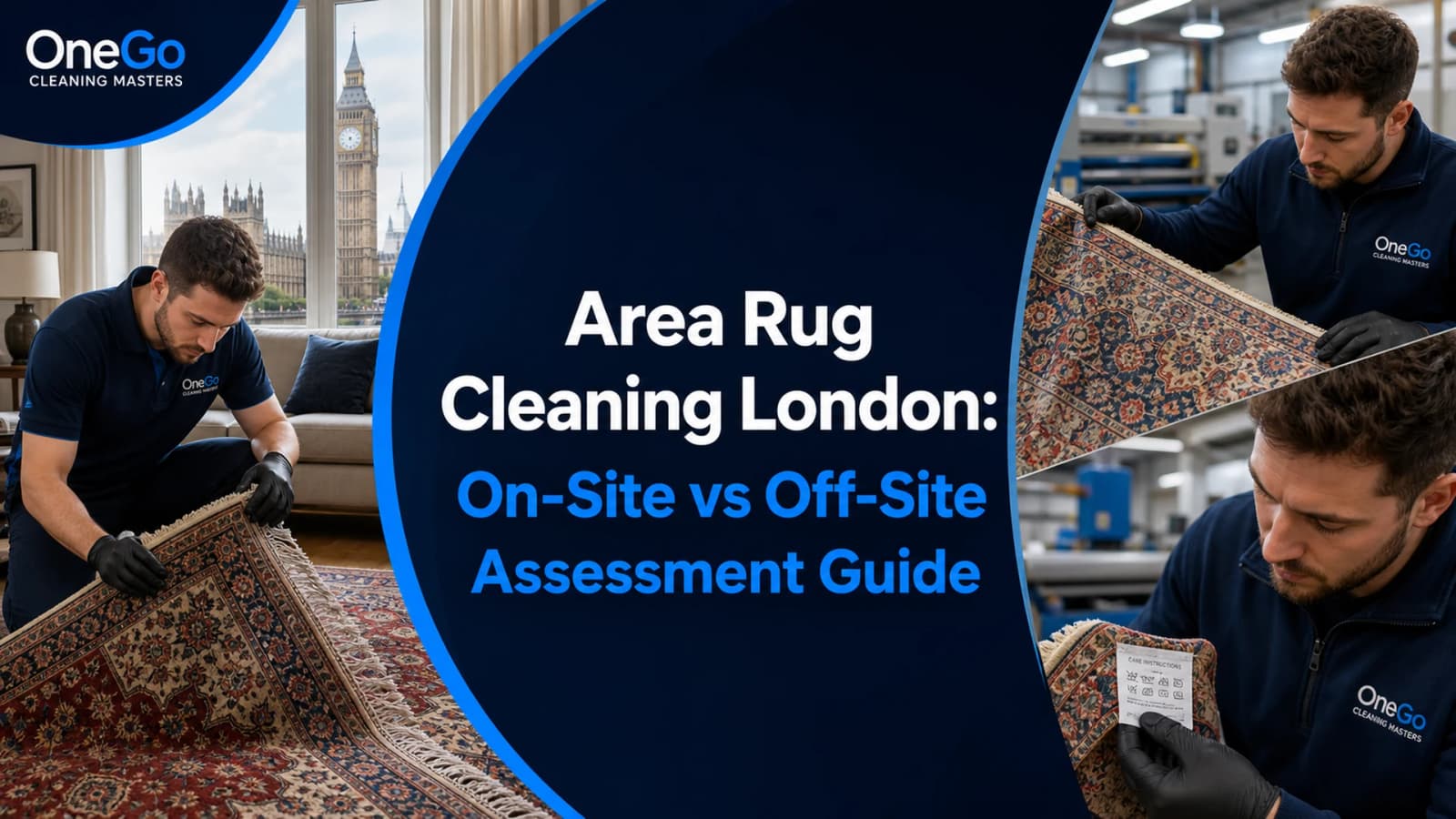
Our on-site and off-site rug cleaning comparison helps structure that conversation. Confirm the actual options with the provider. An article describing possible arrangements is not a live promise that your particular rug can be accepted.
How do you compare proposals without buying a promise?
Compare written proposals for the same rug and concern. Provide the same photographs, care instructions and history to each provider. Check whether the proposal covers assessment, an agreed treatment or another service; these are not interchangeable descriptions of the same work.
Ask which marks may remain and how any physical defects are recorded. Distinguish cleaning from repairing borders, replacing backing or dealing with a building moisture issue. Do not assume those additional tasks are included merely because a provider accepts an initial enquiry.
OneGo's service information provides an overview for enquiries, while its published cleaning prices give starting context. Neither establishes a confirmed price or method for an unidentified natural-fibre rug. Ask the team to confirm whether it can assess your product.
Also agree approval arrangements if the initial scope changes. You should know who can authorise extra work and what happens if treatment is declined after inspection. A clear process is more useful than an absolute restoration claim made before anyone has checked the care sheet.
Frequently asked questions
Can I use a hired carpet-cleaning machine on sisal?
Do not assume it is suitable. Check the actual maker's instructions before using any machine. Alternative Flooring advises avoiding water and steam cleaning for its sisal products. If your rug's identity or guidance is unclear, seek clarification before proceeding.
Does “dry cleaning” mean every product is safe for seagrass?
No. That phrase does not establish compatibility with the particular rug, border or backing. Follow the product-specific instructions and ask about an appropriate method. Do not substitute an unrelated household powder or kit because its label sounds similar.
Can a photograph identify sisal and seagrass reliably?
A photograph can support an initial enquiry but should not replace the product record. Send labels, order details and the care sheet where available. Explain what remains unknown so the provider can decide whether further assessment is necessary.
Can every water mark be removed?
No provider should guarantee that from a general description. Explain the spill and any previous treatments, then ask what can be assessed. Cleaning may have limits, and a remaining appearance change should be discussed before work is approved.
Should I roll up a large rug before the appointment?
Agree preparation with the provider first. Describe its size, furniture and access restrictions. Do not assume that rolling or moving it yourself is required, and avoid blocking shared routes while creating space for assessment.
What if the maker's label is missing?
Search purchase records and contact the retailer or property owner where relevant. If the identity remains uncertain, say so. Ask whether an assessment is possible and what limitations apply rather than selecting a treatment from a similar-looking product online.
Final Thoughts
Natural-fibre rug care begins with the right product information. Find the maker's guidance, record the condition and explain the treatment history. Then compare proposals that address the actual rug, including its border, backing and handling arrangements, with realistic limits on the result.
To ask about suitability, send OneGo your rug details and photographs. Confirm the available assessment route before booking or applying another product.